
Pet Tracking with Industrial IoT: Why a Helmet Tracker Works Better Than a Pet GPS
2026-05-08 09:15:01
62
I didn't set out to track a dog with an industrial safety device. It just turned out that the requirements were almost identical.
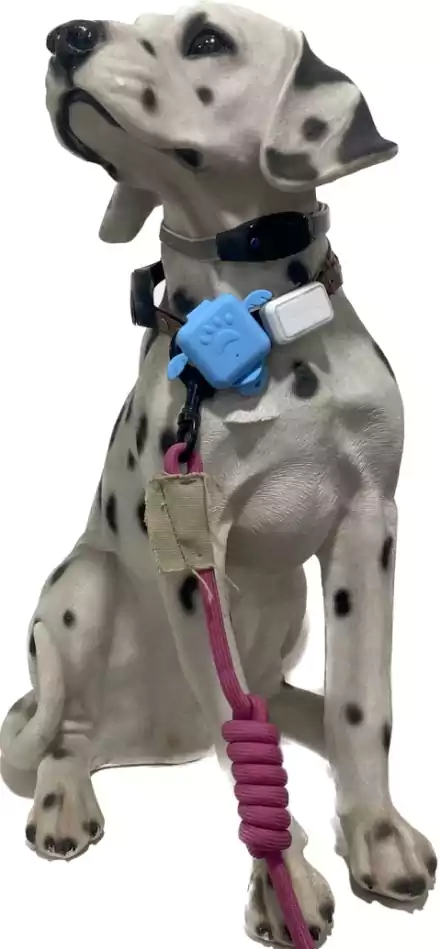
A few months ago, a customer who had bought our G638G helmet tracker for his construction crew sent me an unexpected photo. It was the same 30-gram module, zip-tied to a dog collar. His Golden Retriever, apparently, had a habit of escaping the yard and wandering onto a nearby golf course. The construction site geofences worked. He figured: why not the dog?
He wasn't the first. We've since seen the same module end up on livestock, delivery drones, shipping pallets, and — yes — quite a few pets. This post lays out what we learned about applying industrial positioning hardware to animal tracking, and where it makes sense versus where it doesn't.
The three things every pet tracker gets wrong
If you've shopped for a pet GPS, you've probably noticed the pattern. The devices break down into two camps, and neither is quite right.
1. Bluetooth-only tags (AirTag-style)
These work beautifully — if your dog never leaves a densely populated city. They rely on nearby phones to relay location. Take your Labrador to a rural trail or a beach at dawn, and that tag is suddenly blind. Range isn't a spec; it's a prayer.
2. Cellular pet trackers
These fix the range problem but introduce a battery problem. A full 4G GPS module, pinging every few minutes, drains a small battery in under a day. Most compensate by dialing the update frequency way down. When a dog is running, "location updated 20 minutes ago" is useless.
There's a third problem nobody talks about: offline gaps. Pets don't stay in coverage. They go under barns, into drainage culverts, through dense forest. If the tracker has no local memory, those minutes become permanent data holes. You know where the dog was; you don't know where it went in between.
The G638G wasn't designed for any of this. It was designed for construction workers who spend 10-hour shifts in concrete basements and steel-framed high-rises. But that turned out to matter.
What the hardware actually does (translated to pet terms)
The G638G is a 4G Cat.1 positioning module originally meant to clip onto the rear band of a hard hat. It's 62 × 28 × 16.5mm, 30 grams, IPX7 waterproof. It runs an 800mAh battery that holds 20+ days in standby and 7+ days under normal reporting.
Here's what that means for a dog or a free-ranging cat:
It doesn't panic when it loses signal.
The G638G has 1MB of onboard Flash and a Cortex M4 that keeps running even when the 4G link drops. If your dog disappears into a thicket or a metal shed, the module stores its GPS coordinates and step count locally. The moment it reconnects, it dumps the entire buffer. You get the path, not just the start and end points.
It knows when to shut up and save power.
The on-board accelerometer makes a critical decision: if the device hasn't moved, it stops positioning and stops transmitting. A dog napping under a porch for three hours isn't burning through battery reporting the same location 180 times. In short-connection mode, we've seen units last close to 30 days. That's not a claim off a spec sheet — that's a measured figure from our power-consumption table. (Ask us for that table if you're evaluating hardware; we publish it.)
It doesn't depend on anyone else's phone being nearby.
Unlike Bluetooth crowd-sourcing tags, the G638G uses GPS/BDS + WiFi + cellular LBS + BLE beacon scanning. Outdoors, it falls back on satellite. In a suburban neighborhood, WiFi fingerprinting tightens the fix. If you deploy BLE beacons around your property boundary, you can get geofence accuracy down to 1–3 meters. Your dog crosses the line, you get an alert. No neighbors required.
There's no monthly SaaS fee.
The cloud platform is free. The mobile app is free. The WeChat mini-program is free. The platform is white-label ready, which doesn't matter for a single-dog owner but matters a great deal if you're a breeder, a kennel, or a livestock operation.
How to actually mount this on a pet (and what breaks)
The G638G ships with five plastic mounting clips designed for hard hat bands. Those won't help you. What we've seen work in the field:
For dogs: Heavy-duty zip ties through the module's mounting slots, secured to a wide nylon collar. The 30-gram weight is negligible for any dog over 5 kg. For smaller dogs, it's noticeable but not unmanageable — think of it as a slightly bulky ID tag.
For cats: The weight becomes a real consideration. At 30 grams, most adult cats will tolerate it, but a breakaway collar is non-negotiable. A fixed collar on an outdoor cat is a strangulation risk, and no tracking module is worth that.
For livestock: Ear-tag mounting or integration into existing neck collars. The IPX7 waterproofing means rain and mud won't kill it. We haven't tested prolonged submersion — don't expect it to survive a creek crossing if the cow goes swimming.
What will eventually fail: the magnetic charging cable. It's designed for a construction site trailer, not a muddy kennel floor. Keep the contacts clean, or budget for replacing the cable every 12–18 months. They're standard and cheap.
Where this makes sense, and where it's overkill
Makes sense:
Rural or semi-rural properties where Bluetooth tags are useless.
Dogs that roam off-leash in areas with patchy cell coverage.
Multi-animal operations (kennels, shelters, livestock) that want a single platform with no per-device fees.
Anyone who needs the full path history, not just current location.
Overkill:
Apartment cats that never go outside. A $25 Bluetooth tag does the same job.
Small rodents, birds, reptiles. The module is too heavy and the housing isn't designed for that.
Anyone expecting real-time sub-second tracking. The G638G is designed for periodic reporting to save power. If you need live streaming position data, you need a different architecture entirely.
One thing I'd tell a friend before they buy
Test the cellular coverage where your animal actually goes. The G638G ships with a 3-year IoT SIM for mainland China; we can provide regional SIMs for other countries. But no device can fix a dead zone. Before you commit to any cellular tracker, walk your property boundaries and your dog's favorite escape routes with a phone doing a signal survey. Note the dark spots. That tells you more about whether this will work than any specification table.
If you need the full power-consumption breakdown, the API documentation for third-party platform integration, or just want to ask whether this makes sense for your specific situation, contact us directly. We answer those emails with real engineering advice, not a sales script.
*The G638G is primarily a helmet-mounted industrial positioning module. You can find the full technical specifications, model variants (4G, LoRa, Cat.M), and ordering information on the G638G product page.*